
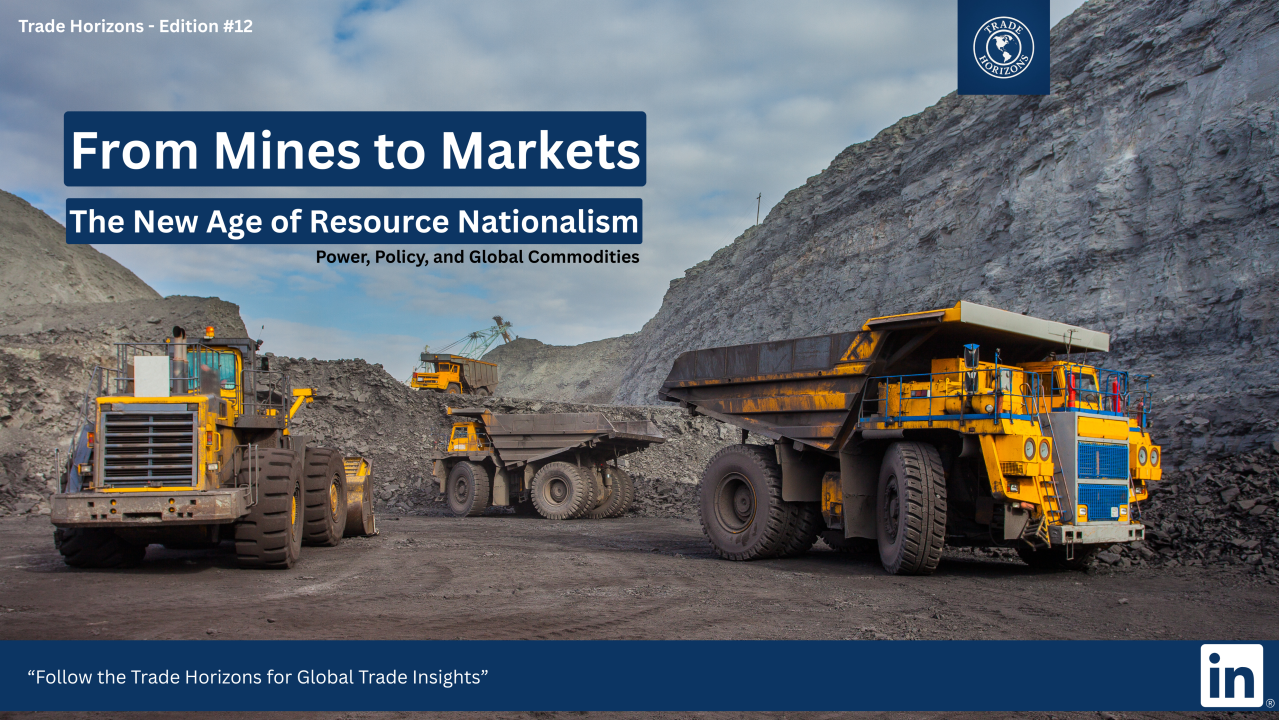
Why governments are reclaiming control — and how global capital must adapt
🌍 The Silent Shift Reshaping Global Commodities
A profound shift is underway in global commodity markets. Not driven by prices. Not driven by demand. But driven by state power.
Across Africa, Latin America, and parts of Asia, governments are reasserting control over natural resources — from lithium and copper to oil, gas, and rare earths.
This movement has a name: Resource Nationalism. And it is redefining how commodities move from mines to markets.
🔹 What Is Resource Nationalism?
Resource nationalism refers to policies where governments:
1. Increase state ownership in mining and energy assets
2. Raise royalties, taxes, or export duties
3. Restrict raw material exports
4. Mandate local processing and value addition
5. Renegotiate legacy contracts
Once cyclical, resource nationalism is now structural — driven by geopolitics, climate goals, and fiscal pressure.
🔹 Why Resource Nationalism Is Rising Now
1️⃣ Energy Transition Pressure
Critical minerals are no longer optional — they are strategic. Lithium, copper, nickel, cobalt, and rare earths are now viewed as national security assets, not just commodities.
Governments want control over materials that power EVs, grids, and defense systems.
2️⃣ Fiscal Stress & Sovereign Revenue Needs
Many emerging economies face:
1. High debt
2. Currency pressure
3. Social spending demands
Resources are the fastest way to rebuild fiscal strength.
3️⃣ Geopolitical Fragmentation
As global trade becomes multipolar, countries are reducing dependency on foreign-controlled supply chains.
Owning the resource means owning leverage.
🔹 Where This Is Playing Out
🌍 Africa
1. Higher mining royalties
2. State participation in strategic assets
3. Push for local beneficiation
🌍 Latin America
1. Lithium nationalization debates
2. Copper tax reforms
3. Stronger regulatory oversight
🌍 Asia
1. Export restrictions on critical minerals
2. Strategic stockpiling
3. Domestic processing mandates
The result: supply chains are becoming political assets.
🔹 Implications for Global Trade & Investment
💠 For Investors & Funds
Country risk is now as important as commodity risk
JV structures outperform pure ownership
Political alignment matters as much as IRR
💠 For Traders & Commodity Houses
Long-term offtake agreements require sovereign engagement
Compliance, traceability, and local partnerships are mandatory
Speed alone is no longer enough — credibility matters
💠 For Governments & Policymakers
Balancing capital attraction with national interest is critical
Excessive control risks capital flight
Smart nationalism attracts aligned capital, not speculative capital
🔹 The New Playbook: Adapt or Exit
The era of extract → export → profit is ending.
The new commodity model is:
Local value addition
Strategic partnerships
Shared upside between state and capital
Long-term alignment over short-term extraction
Those who fail to adapt will lose access. Those who align will secure supply for decades.
🧭 The Takeaway
The next commodity wars won’t be fought over price. They’ll be fought over access.
In the new age of resource nationalism:
Markets don’t decide everything
Governments matter
Alignment beats arbitrage
From mines to markets, power has shifted upstream.
📖 Read the full edition → https://www.linkedin.com/newsletters/7369292290483216386/
Beyosce Global Ventures Pvt Ltd (Ventrix Trade)
#TradeHorizons #ResourceNationalism #GlobalCommodities #Geoeconomics #Mining #EnergyTransition #VentrixTrade #Globalshift

Leads the company’s global vision, trade strategy, and technological innovation. His focus on sustainable partnerships and digital transformation drives Ventrix’s international success.